
High-grade carbon materials from biomass, targeting metallurgy, semiconductor manufacturing, agriculture, and carbon credit markets.
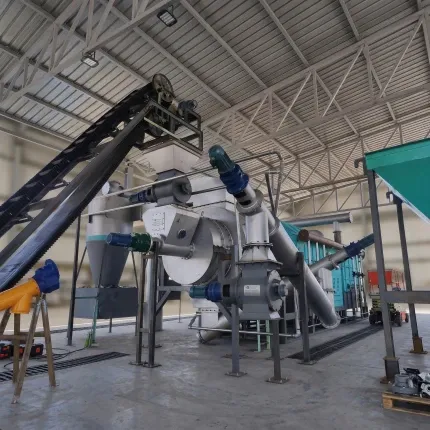
Not all biomass value is captured through combustion or densification. Through controlled thermochemical carbonisation, biomass transforms into high-grade charcoal and biochar: carbon-rich solid materials with critical applications in metallurgy, semiconductor manufacturing, activated carbon production, agricultural soil enhancement, and internationally recognised carbon sequestration frameworks. Our multi-stage carbonisation systems achieve a 40 to 42% carbon recovery rate from biomass feedstock, consistently and at industrial scale, turning waste biomass into one of its highest-value possible outputs.
The fundamental difference between modern industrial carbonisation and traditional kiln production comes down entirely to process control. Traditional kilns rely on weather-dependent, manual operation that exposes raw material to direct combustion, burning a portion of the feedstock to generate process heat. This sacrifices material, concentrates ash, reduces caloric value, and produces approximately 4 tonnes of harmful emissions per tonne of charcoal output. Our closed-system, indirect-heating multi-zone carbonisation furnaces eliminate direct combustion entirely. Three distinct thermal zones, operating up to 200°C, 300°C, and 600°C in sequence, guide biomass through a precise, non-combustive transformation. The result is structurally intact, high-purity charcoal with minimal ash and maximum energy density.
The same controlled process produces two market-ready outputs depending on configuration and feedstock. Industrial charcoal, produced as large, intact, high-carbon-purity pieces, serves demanding markets in non-ferrous metallurgy, silicon and semiconductor manufacturing, military-grade activated carbon, and chemical production. Agricultural biochar, produced from the same thermal platform with parameter adjustments, delivers measurable soil enhancement and carbon sequestration at scale, with each tonne sequestering approximately 3 tonnes of CO₂ equivalent. Carbon credit monetisation adds a financial layer to the agricultural biochar output that grows as carbon markets mature.
Seven sequential stages make up the complete biomass-to-carbon conversion cycle, from raw material preparation through drying, pyrolysis, emission control, cooling, and final product output. Click any step to read its detailed description.
Three independently controlled thermal zones, operating up to 200°C, 300°C, and 600°C, guide material through a gradual, non-combustive transformation with no oxygen contact and no direct combustion. That control difference is what separates a 40 to 42% recovery rate from the 25 to 30% typical of traditional kilns, and large intact charcoal from dust-dominated output.
Vertical material loading is mechanically and thermally superior to horizontal drum configurations. It eliminates the bridging failure mode, harnesses the natural rise of convective gases, and aligns with the longitudinal fibre structure of wood to optimise volatile compound exit pathways. Every particle in a vertical furnace receives equivalent thermal exposure, producing the uniform carbonisation depth that defines premium output quality.
This recovery rate is achieved by eliminating direct combustion entirely. In traditional kilns, feedstock burns to provide process heat: the fuel and the product compete for the same material. In our indirect-heating architecture, all feedstock goes toward product conversion. The result is large, structurally intact charcoal with high caloric value, minimal ash, and consistent carbon purity: the characteristics that command industrial premium pricing.
Mechanically densifying the feedstock before carbonisation removes the thermal inconsistency that raw biomass geometry introduces. Standardised briquettes carbonise uniformly, and the most common failure mode of raw-material carbonisation — dusty and fragmented output dominated by fines — is eliminated at the feedstock stage. Operations targeting metallurgical-grade or semiconductor-grade output benefit most from this integration.
Traditional kilns producing one tonne of charcoal release approximately 4 tonnes of harmful emissions, a regulatory, community, and environmental liability. Our closed furnace design captures pyrolysis gases, uses them internally as process heat, and controls final flue gas discharge through an afterburner and emission treatment system. Environmental compliance is a design feature, not an afterthought.
The same carbonisation platform produces either industrial charcoal or agricultural biochar by adjusting process parameters, residence time, zone temperatures, and feedstock type. Operations can target metallurgy and semiconductor markets, agricultural markets, or split production between both depending on where prices are strongest. This flexibility protects the investment against single-market price exposure.
Get In Touch
Tell us about your feedstock, target output, and market. Our engineering team will put together a customised carbonisation system configuration and respond within one business day.